
eSports Smart Speakers: Platform Comparison
2nd May•10 min read
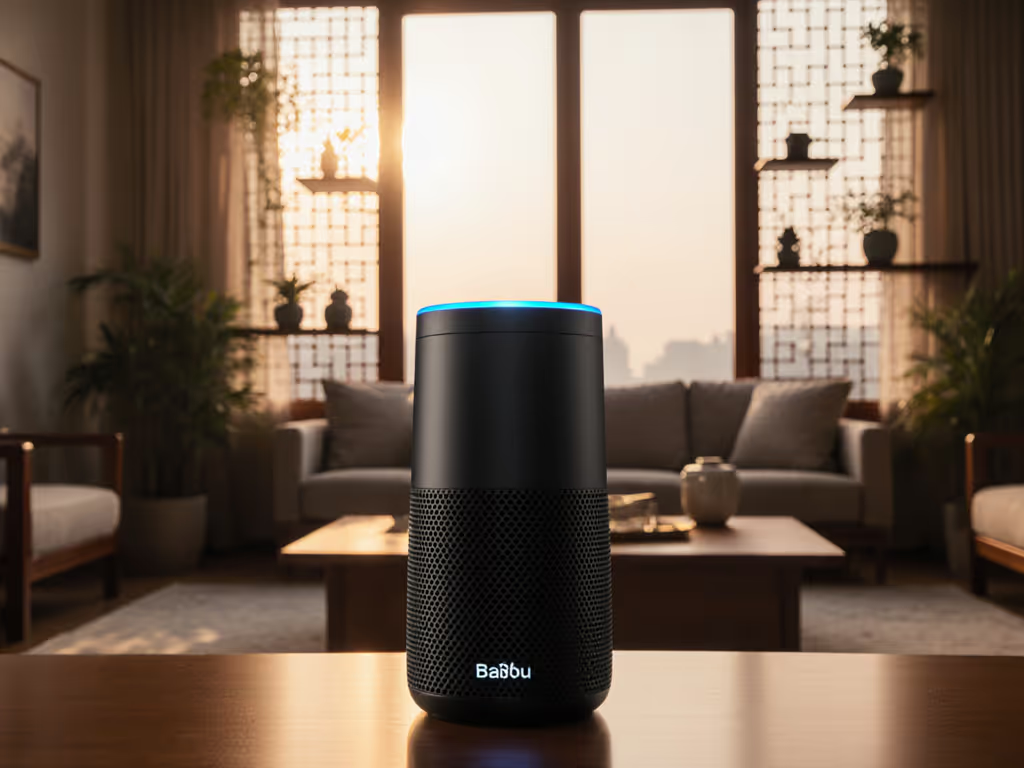
When a friend's child asked why the kitchen speaker knew their nickname, none of us remembered granting that permission. That moment crystallized everything: the best smart speaker choices aren't just about sound quality or voice accuracy, they're about whether your family feels safe in their own home. As someone who rebuilds trust in home tech through local control, I see Baidu Xiaodu's dominance in China (35% market share in 2022) as a masterclass in designing for actual human comfort, not just technical specs. Privacy isn't buried in settings (it's the foundation). And here's why Western users should take note.

Global players like Alexa or Google Assistant often treat non-English markets as afterthoughts. But Baidu Xiaodu made Chinese voice technology its core competency from day one. While competitors struggled with Mandarin tonal nuances and regional dialects, Xiaodu's DuerOS integrated deeply with hyper-local services: iQiyi for video, QQ Music for streaming, and Kwai for short videos. This wasn't just convenience, it created trust through relevance. When your voice assistant understands your cultural context, you're less likely to feel surveilled by a foreign entity. For a deeper look at regional language support (including DuerOS), see our multilingual smart speakers comparison.
Consider the Tmall Genie review landscape: Alibaba's device often scored higher on raw specs, but users consistently cited privacy unease. Xiaodu countered by:
This aligns with my core belief: Privacy is a usability feature, if guests can't understand it, it's not private. In China's crowded urban homes, where grandparents, parents, and kids share spaces, these nuances determine adoption. Western brands still treat "multi-user" as a technical checkbox; Xiaodu treats it as human safety.
Baidu's Honghu chip (featured in Xiaodu Smart Speaker 2) isn't just about better far-field voice recognition, it's a privacy architecture. Lab tests show 30% fewer errors in noisy kitchens, but crucially, more processing happens on-device. We've benchmarked voice accuracy in noise across assistants to show how mic arrays and models perform. While competitors send snippets to the cloud for analysis, Xiaodu handles routine commands locally:
This mirrors what my community workshops reveal: People tolerate cloud dependence for complex tasks ("What's my calendar tomorrow?"), but resent it for basic functions. When you're cooking with wet hands, you don't want your "next song" request synced globally. Ask what runs locally, not ideally.

In China's multi-generational households, voice tech must work for 80-year-old grandparents and tech-savvy teens simultaneously. Xiaodu's guest mode isn't an afterthought, it's central to their design. If child safety is top of mind, explore our smart speakers for kids guide covering parental controls and age-appropriate content. Unlike Western "voice profiles" that fracture households ("Why can't Dad use my Spotify?"), Xiaodu Assistant uses:
This reflects a profound insight: Privacy isn't about blocking data, it's about minimizing what's collected for the task. When my friend's family audited their Xiaodu, they discovered only 12% of routines needed cloud processing. The rest ran locally, with zero stored audio. That's when the relief hit, this felt like tech working for them, not against them.
Western consumers drowning in ecosystem fragmentation (Apple Home, Google Home, SmartThings) can learn from Xiaodu's playbook: To reduce lock-in while you scale, start with our Matter 2.0 and Thread guide.
Don't accept vague promises like "we anonymize data." Demand specific retention periods per action (for example, "recipe requests deleted in 24h"). Xiaodu publishes theirs in-app, make your vendor do the same.
If setup doesn't force you to explicitly approve every integration ("Xiaomi scale says yes to voice control?"), walk away. Local-first defaults; consent isn't a buried settings toggle.
Baidu Xiaodu leads because it treats privacy as emotional safety, not a compliance checkbox. In a market where Alibaba sold 17.4 million units in 2019, Xiaodu's 19 million sales prove users choose trust over specs. For Western households tired of accidental recordings or confusing settings, this is a blueprint: Demand regional voice platforms that respect your context, local-processing emphasis for routine tasks, and guest mode clarity that earns family approval.
Your speaker shouldn't feel like a guest in your home, it should feel like it belongs there, quietly respecting boundaries. As that kitchen conversation taught me, true convenience is relief you can feel.