Smart Speaker Offline Capabilities: Local Processing Tests
2nd Jun•11 min read
Understanding smart speaker pricing strategy and the underlying voice assistant business economics is the difference between buying a cheap gadget and designing a resilient, low-stress home system. The sticker price on the box rarely reflects what you're really paying for over five years, whether in subscriptions, data, or the cost of being locked into a single ecosystem.

In this FAQ deep dive, I'll unpack how subsidies, lock-in, and long-term value interact, so you can choose speakers that support the way you live, not the way a platform wants you to spend.
Measure, don't guess: sync matters more than flashy features.
Because many are priced as loss leaders in a broader ecosystem, not as stand-alone profitable products.[4] A loss leader is sold below its true economic cost to pull you into an ecosystem where the company earns money elsewhere, through shopping, services, or ads.[4] For a deeper look at platform economics, see our smart speaker business model explainer.
From a smart speaker cost structure standpoint, the bill of materials (mics, amplifier, drivers, Wi-Fi/BT module, SoC, enclosure), manufacturing, and distribution often add up to more than the ultra-low sale price during promotions, especially in the $20-$40 range cited for entry-level devices.[2] Marketing and ongoing cloud costs sit on top of that.[2]
Vendors can do this because they expect downstream revenue from:
In that model, your home becomes an on-ramp to recurring revenue, so the hardware pricing economics favor aggressive subsidies up front.
The voice assistant subsidy model is simple: keep hardware cheap and omnipresent; make money when you talk to it.
In Amazon's Alexa strategy, for example, analysts and commentators have long highlighted aggressive hardware subsidization as a core adoption lever, backed by deep integration into e-commerce and content.[8] Cheap speakers expand the installed base, which then justifies a large developer ecosystem and cross-selling of services.[8]
For a typical assistant platform, the revenue stack looks like this:
Your low-cost speaker is effectively a voice front-end for higher-margin digital services. The platform can tolerate low or negative smart speaker profit margins if each household produces reliable downstream revenue over time.[4][8]
Industry analysis places the global smart speaker market's total addressable value in the mid-tens of billions of dollars within this decade, with projections in one report estimating around $13.4-$18.9 billion by 2026 and a strong compound annual growth rate through 2031.[5]
Scale matters because:
This is why platforms chase volume with steep discounts. Once they reach critical mass, even small per-user monetization improves overall economics.
For mass-market speakers, hardware is rarely the main profit engine over the product's life.
In many cases, the primary value is your ongoing engagement and the behavioral data that comes with it (a point frequently raised by critics who note that "your data is the real price" when hardware is sold at a loss).[4]
Roughly speaking, revenue comes from three layers:
When you evaluate a device, it helps to ask: Is this priced like a product, or like a conduit for something else the company wants to sell me?
Ecosystem lock-in is central to smart speaker pricing strategy. If you're weighing platforms, start with our Echo vs Google Home comparison focused on avoiding lock-in. The lower the initial hardware price, the more likely the vendor expects to recuperate costs via increased switching costs and long-term dependence on their platform.
Lock-in shows up across several dimensions:
Once you have 6-10 speakers spread across rooms, the exit cost (time, money, and frustration) is substantial. Many households just accept the friction instead of rebuilding. That's not an accident; it's an economically rational design choice for the platform.
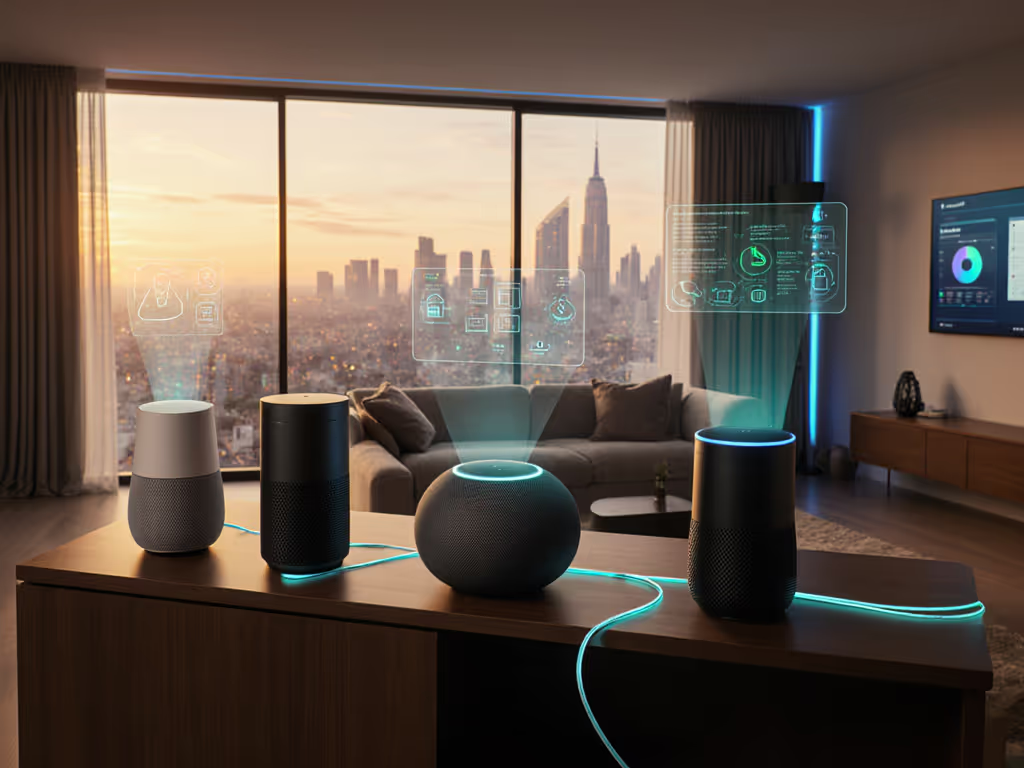
I still remember a birthday dinner where three brands of speakers drifted milliseconds out of sync mid-toast. The echo was annoying, but what struck me more was how each brand tried to pull the household deeper into its own app and service bundle instead of playing nicely with the others.
Exact numbers vary and detailed bills of materials are rarely public, but we can outline the smart speaker cost structure qualitatively.
For an entry- to mid-range model, major cost buckets include:
When you see:
Because the industry doesn't publish detailed cost breakdowns, treat these as directional: you are paying either in higher up-front price, higher downstream monetization, or both.
Subsidies and lock-in reshape your total cost of ownership (TCO) in three ways:
Subscriptions vs. hardware cost A practical rule used by some analysts: compute ( (\text{Monthly subscription} \times 12) / \text{Hardware price} ). If this ratio is more than ~24 months, the subscription may cost more than replacing the hardware over a short horizon.[3] That's a clear red flag for long-term value.
Reduced flexibility A subsidized, tightly locked ecosystem might be cheap today but expensive to exit later if you switch phones, move country, or need better standards support (Matter, Thread, AirPlay, Chromecast).
Privacy and data cost When the hardware is underpriced, the vendor has a stronger incentive to monetize via behavioral data and ads.[4] You can mitigate some of this by following our smart speaker privacy controls guide. Even if this doesn't show on your bill, it affects recommendation bias and how "neutral" your assistant feels.
If your goal is calm, predictable routines rather than endless upsell prompts, it can be worth paying more up front for devices that rely less on aggressive monetization. The peace of mind often pays for itself.
Devices that emphasize open standards - Matter 2.0 and Thread, AirPlay, Chromecast, Spotify Connect - often lean toward:
These products might not win the race to the bottom on sticker price, but for a systems-thinking household, they often win on:
You are effectively paying a modest "interoperability premium" to reduce future re-architecture costs.
Here's a simple, reproducible way to benchmark voice assistant business economics at the household level. Treat it like a mini lab test:
Measure, don't guess: sync matters more than flashy features - and so does the real 5-year cost once subscriptions and lock-in are factored in.
This benchmarking turns a vague "feels cheaper" impression into a concrete, room-by-room cost profile.
Use these as a pre-purchase checklist:
Pricing & subsidies
Is this price plausible for the hardware, or clearly a loss leader?
What is the vendor's main business model: hardware, services, or ads?
Lock-in & interoperability
Does it support Matter/Thread and open casting protocols (AirPlay/Chromecast/Spotify Connect)?
How hard would it be to migrate routines to another ecosystem?
Subscriptions & features
Which features stop working without a subscription?
Are core voice controls and local automations subscription-free?
Privacy & data
Are there clear, hardware-level mic mutes and indicators?
Can I disable voice recording storage or ad personalization?
Longevity & support
What is the stated support / update window?
Does the vendor have a history of abandoning devices after 2-3 years?
These questions push vendors toward more transparent hardware pricing economics and help you avoid surprise costs later. They also help you stay focused on long-term value.
If you treat your home like a long-lived system instead of a gadget drawer, smart speaker pricing strategy becomes a design parameter, not an afterthought.
For further exploration:
Over time, this kind of measurement gives you buy-once confidence: you will see which combinations of standards, vendors, and price points actually deliver calm, predictable performance instead of pushing you deeper into invisible costs.