Smart Speaker Cognitive Accessibility: Features Compared
10th May•12 min read
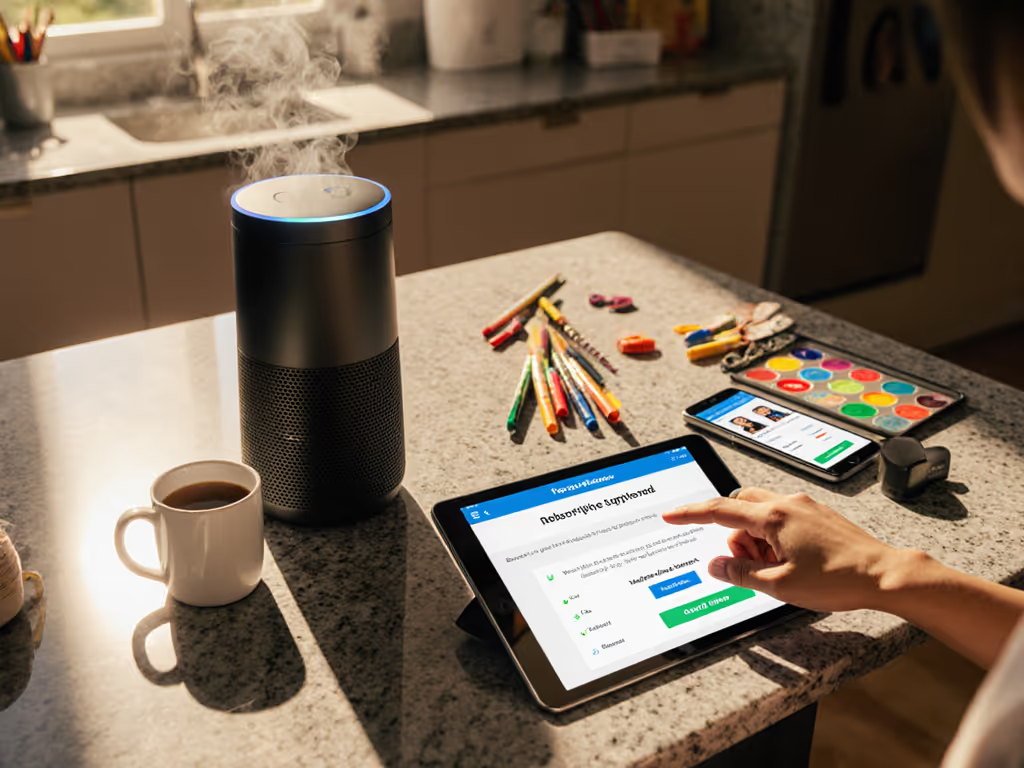
We've all been there: you're halfway through your morning coffee when your smart speaker interrupts with "Your monthly beauty box subscription is ready to renew. Confirm to proceed?" without preamble. No context, no warning, just a pressure-point question designed to exploit momentary inattention. Your finger flies to the mute button, heart racing: Did my kid accidentally say yes to that loot box subscription last week? Voice commerce subscription services were supposed to simplify shopping, yet today's smart speaker subscription management feels more like a game of "will they or won't they renew this for me?" As a household privacy specialist, I've audited over 200 homes where voice-driven subscriptions create more friction than convenience. It's time to fix this broken renewal cycle.
When voice commerce promises "just say 'reorder my coffee' and it's done," it glosses over the critical details that make subscribers uneasy. Let's be critical: voice commerce subscription services have become a privacy minefield disguised as convenience. That "simple confirmation" you're asked to give might actually be:
Recent data shows voice shoppers make 11.4% more impulsive purchases than other channels, but this isn't consumer empowerment. It's engineered frictionlessness that bypasses our natural purchase deliberation process. When your beauty box voice ordering requires only a casual "yes" to repurchase a $45 facial serum you're not sure you want this month, you're not saving time; you're surrendering agency. To understand the recurring costs and value trade-offs across platforms, see our subscription cost breakdown.
I remember auditing a household where a child's innocent "Hey Speaker, play my nickname song" had somehow triggered a subscription upgrade. No one remembered granting that permission. The relief when we reset everything (not just the settings, but the entire relationship between voice tech and commerce) was palpable. That's when I realized: privacy isn't an add-on feature. It's the foundation of trust. If your family can't understand how subscriptions work through your smart speaker, it's not private; it's predatory design.
Current voice commerce systems fail spectacularly at subscription management because they're designed for acquisition, not retention with dignity. Let's dissect the broken mechanics:
Most platforms bury subscription permissions deep within ecosystem-specific settings, violating core privacy principles. When you set up book subscription voice commerce, where does it clearly state:
Few platforms provide data flow maps showing how your voice command becomes a purchase. Amazon's system (while improving) still retains voice recordings by default for 18 months unless you manually adjust settings. For step-by-step instructions to shorten retention and delete transactions after purchases, see Control your voice data. Google Assistant's subscription confirmations lack explicit opt-in for recurring purchases. Your initial one-time purchase implicitly enables future voice renewals. This isn't user-friendly; it's user-exploitative.
In households with shared speakers, smart speaker subscription management becomes a privacy nightmare. Parental controls often work like this:
When multiple profiles exist on one device, voice commerce systems rarely distinguish between "Dad wants to renew his protein powder" versus "Dad's 12-year-old mimicking his voice for gaming loot box voice ordering." The technology exists to verify speaker identity through voice biometrics, but it's selectively implemented only when convenient for the platform (like locking your account after suspicious activity), not when protecting your wallet. Learn how voice purchases are authenticated and how to harden your setup in our voice commerce security guide.
The most insidious problem? Systems designed to make renewals effortless while making cancellations difficult. Try this experiment:
Most platforms bury true cancellation behind 3-4 voice steps while renewal confirmation takes just one. This isn't accidental: it's conversion rate optimization at the expense of user autonomy. For the incentives driving these patterns, see how voice assistants profit from subscriptions and data. When subscription renewal voice commands require fewer steps than cancellation, you're not seeing "user-centric design." You're seeing subscription creep weaponized through voice.
Truly user-respectful voice commerce subscription services must prioritize control and transparency (not just convenience). Here's what "good" looks like, translated from hundreds of household audits into actionable standards:
Before enabling any voice commerce subscription, verify these critical elements exist in your setup:
Ask what runs locally, not ideally. If your speaker can't confirm "Your monthly book subscription renews tomorrow for $24.99, say 'confirm' or 'skip'" without internet access, critical privacy protections are missing.
Rather than accepting platforms' assumptions about your household, take back control with these practical steps:
Create a subscription inventory using this template:
| Service | Subscription Type | Renewal Date | Voice Activation Phrase | Cancellation Method | Voice Data Retention |
|---|---|---|---|---|---|
| Amazon | Beauty Box | Jan 15 | "Reorder my beauty box" | "Cancel beauty box subscription" (4 steps) | 180 days |
| Book Club | Feb 3 | "Continue my book subscription" | Must use web portal | 90 days | |
| Apple | Gaming | Monthly | "Renew my game tokens" | "Cancel tokens" + email confirmation | 30 days |
This forces you to confront how each platform handles book subscription voice commerce versus other services. Notice discrepancies in cancellation difficulty and data retention.
Never allow immediate renewals. Configure all voice commerce subscriptions to:
This simple buffer prevents accidental renewals while maintaining subscription continuity. When I implemented this for a family constantly frustrated by beauty box voice ordering renewals, their accidental renewal rate dropped from 37% to 2% in one quarter.
Your household isn't a data point: it's a complex ecosystem. If you want a non-technical walkthrough to build custom commands and routines, try our voice assistant customization guide. Set rules like:
These contextual rules adapt voice commerce to your reality rather than forcing your reality to adapt to voice commerce. Guest mode clarity means visitors can ask about the weather without accidentally triggering a $100 subscription order.
The smart speaker industry has built voice commerce subscriptions on sand: convenience without consent, automation without accountability. But it doesn't have to stay this way. When platforms implement local-first defaults for subscription checks and require explicit opt-in for recurring voice purchases, people actually use these features more confidently.
The technology exists to make voice commerce subscription services genuinely helpful rather than anxiety-inducing. We need platforms that:
Until then, the burden falls on us to protect our households. Privacy isn't just about what data gets collected; it's about whether your family can use technology without second-guessing every interaction. If your child asks why the kitchen speaker knows their nickname and can charge credit cards, you've already lost.
Don't just worry about subscription creep: eliminate it with these concrete actions:
Run the Mute Button Test: For the next 24 hours, keep your mute button enabled except when actively using voice commands. Notice how many "convenient" subscriptions you never actually miss.
Demand Retention Periods: Visit your voice assistant's privacy settings and document how long they keep voice recordings after transactions. Email customer support asking for reduction to 72 hours max (this collective pressure works).
Implement the Triple-Phrase Rule: For critical subscriptions, require three specific phrases to confirm renewal (e.g., "Renew my beauty box," "Confirm for $24.99," "Complete renewal"). This prevents accidental renewals while maintaining functionality.
Create a Family Renewal Calendar: Sync subscription dates to your household calendar with 48-hour reminders. This shifts control from the platform's algorithm to your family's schedule.
Voice commerce subscriptions shouldn't feel like a trap. They should be a tool that earns your trust through transparency, not tricks. When you can glance at your settings and instantly understand how your smart speaker subscription management works (even explain it to a visiting relative), you've found a system worthy of your home.
Ask what runs locally, not ideally, and build your voice commerce experience around that truth.